
Google’s Jan 9th Update vs. Your Clients’ Inbox: Change this NOW

Introduction
I’ve spent the last two years helping clients generate content—good content—using AI. Because I live in these tools every day, I can spot “sloppy AI” a mile away. The awkward phrasing, the overuse of the word “delve, quiet and unleashed” the lack of a strong opinion—it stands out instantly.Google sees it. And it’s doing something about it – right now.
With the January 9th algorithm update, Google has decided to solve the problem. While everyone is panicking about their search rankings, a more dangerous shift happening in your clients’ Inbox. Generic, AI-generated content is now getting filtered out before your audience ever sees it. Here is why that is happening and how you need to pivot your strategy starting today.What Is the E-E-A-T Framework?
To understand the crackdown, you have to understand the filter. Google is applying its E-E-A-T framework (Experience, Expertise, Authoritativeness, and Trust) more aggressively than ever….with AI.- Experience: Have you actually done the thing you’re writing about?
- Expertise: Do you have real knowledge in this area?
- Authority: Are you a credible voice on this topic?
- Trust: Can readers believe what you’re saying?
The Problem with “AI Slop”
Since I’ve been training clients on these tools for two years, I know exactly what the “slop” looks like. It opens generically.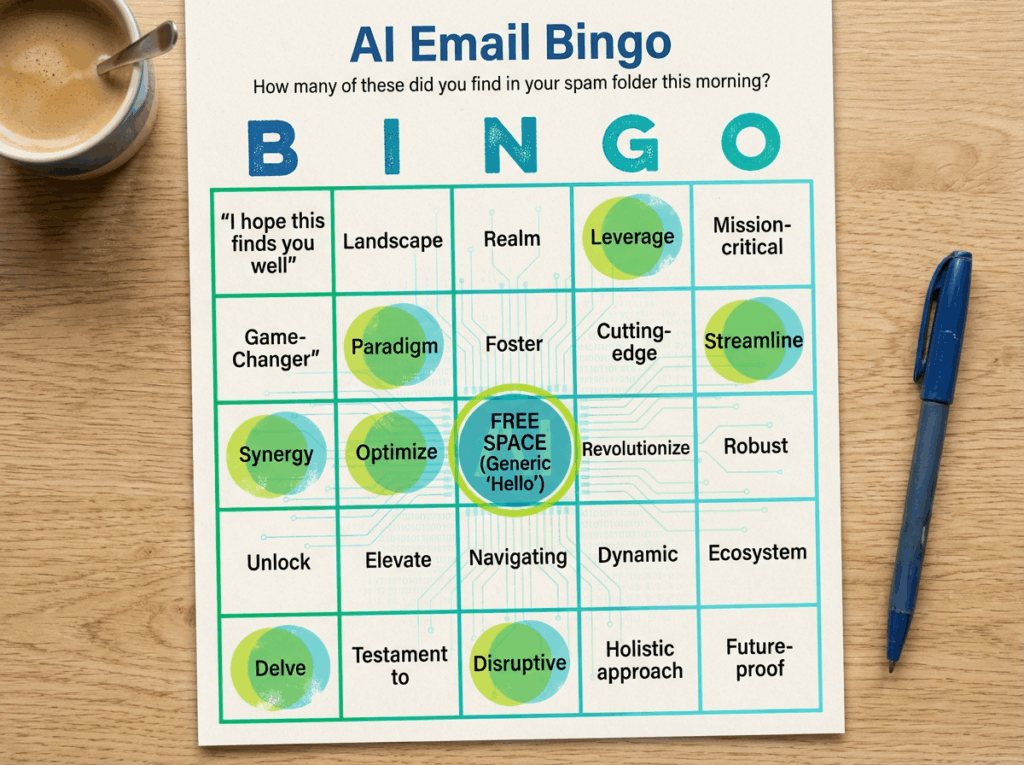 It’s generic, impersonal, and completely interchangeable. The algorithms now recognize this pattern immediately. The same goes for the classic listicle format: “5 Best Practices for X.”
These structures have become so overused that they are now red flags.
It’s generic, impersonal, and completely interchangeable. The algorithms now recognize this pattern immediately. The same goes for the classic listicle format: “5 Best Practices for X.”
These structures have become so overused that they are now red flags.
The Fix: Specificity and Lived Experience
The antidote to AI slop is specificity. You need to write things that a machine simply couldn’t know because it wasn’t there. It’s YOUR authority and experience.Example 1: The Opening Hook
 The “Sloppy AI” Version:
“In today’s fast-paced business world, staying ahead of the competition requires innovation.”
 The “Experience” Version:
“I spent three hours yesterday arguing with my CTO about whether to sunset our legacy product. Here’s what we decided.”The Difference: The second version proves you were in the room. It implies a specific event and a human resolution.
Example 2: The Value Prop
The “Sloppy AI” Version:
“Here are 5 best practices for improving your sales pipeline.”
The “Experience” Version:
“We tried the most popular best practice for pipeline management—and it completely failed. Here’s why.”The Difference: Flipping from “best practices” to “lessons learned” adds the kind of authenticity that passes the new filters.
Your “Right Now” Action Plan
To protect your deliverability, audit your nurture sequences this week:- Kill the Generic Openers: If your email starts with “I hope this finds you well,” delete it.
- Inject Your Experience: Use phrases like “In my experience” or “When I tested this.”
- Refresh Your Sequence: If your nurture emails haven’t been touched in 6 months, they likely sound like an older, dumber version of ChatGPT. Rewrite them with your current voice.
The Bottom Line
Google is pushing us toward better, more human communication—and honestly, it’s overdue. The era of pumping out volume with AI shortcuts is ending. What’s replacing it? Real voices, real experiences, and content that actually earns attention.